티스토리 수익 글 보기


Developed jointly by ITU, WHO and WIPO under the Global Initiative on AI for Health (GI-AI4H), this publication aims to help innovators, policymakers and health stakeholders navigate the responsible development and deployment of AI-enabled health innovations. It provides practical guidance on intellectual property, commercialization pathways, and health data governance and standards, showing how these interconnected areas can support innovation while safeguarding public health. Drawing on real-world case studies, the publication offers actionable insights to help transform AI-driven health solutions into scalable, sustainable and impactful innovations that benefit patients and populations worldwide.

Within the framework of AI Solutions, Standards, and Skills, and mainly under the Skills and Capacity pillar of AI for Good, the AI for Good Lab mission is to enable developing and middle and low income countries to develop the local AI ecosystems to be able to harness the potential of frontier technologies such as Artificial Intelligence (AI) and Machine Learning (ML) and address the challenges related to AI skills development for the workforce, professionals, government, startups and youth. It provides a collaborative ecosystem that brings together governments, academia, industry, civil society, and startups to develop, evaluate, and scale AI solutions for social, economic, and environmental impact. The Lab contributes to strengthening ITU capacity to respond to the increasing demand for AI solutions based on international standards. More information about the AI for Good lab is available on the website: https://aiforgood.itu.int/ai-for-good-lab.
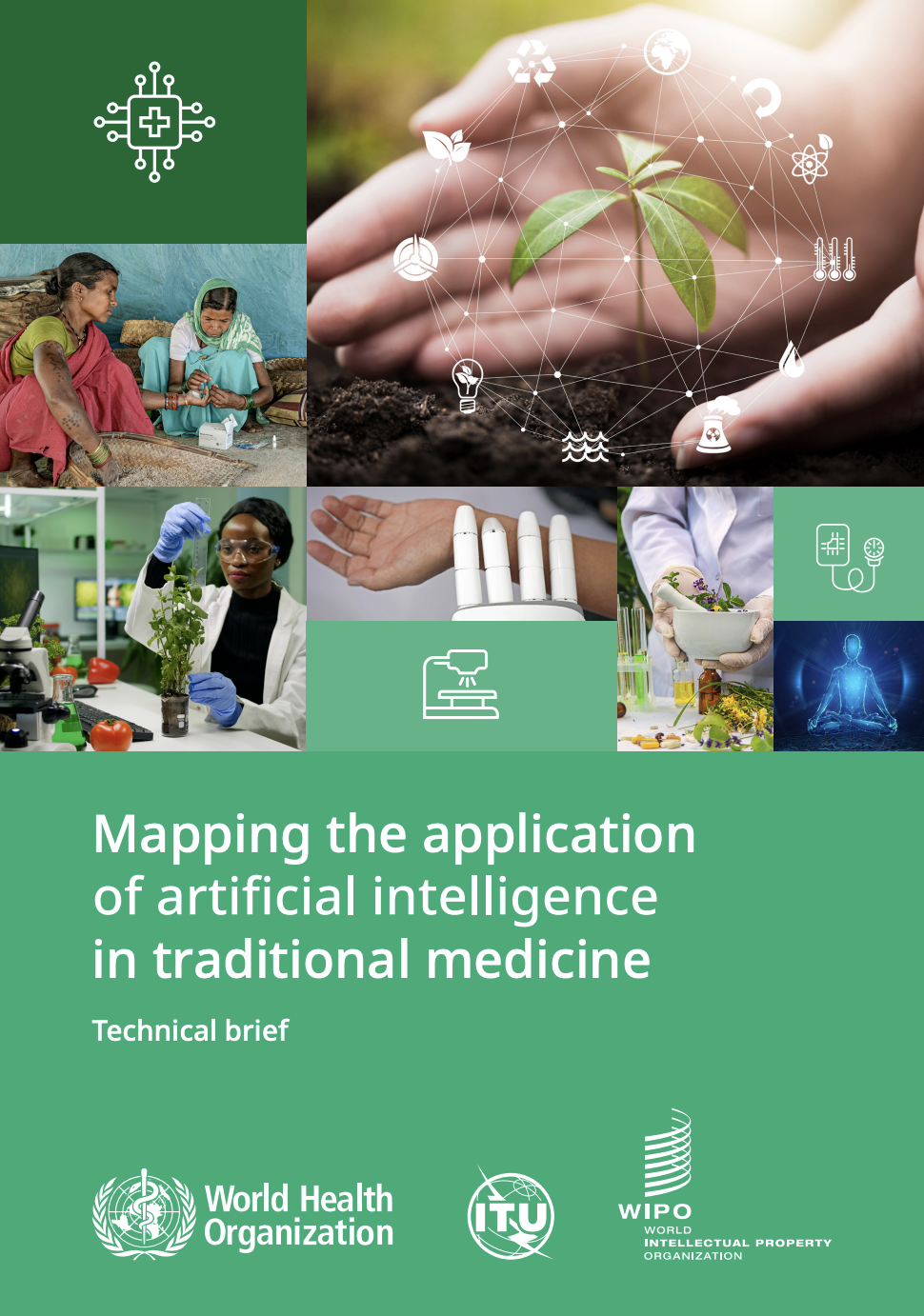
Mapping the Application of Artificial Intelligence in Traditional Medicine is a joint technical brief by WHO, ITU and WIPO, developed in the context of the Global Initiative on AI for Health (GI-AI4H). It explores how AI is being applied in traditional medicine, including clinical decision support, diagnostics, personalized care, medicinal plant identification, drug discovery, health system management and preservation of traditional knowledge. Drawing on global case studies and expert consultations, the brief highlights opportunities to advance research, innovation, access to care and universal health coverage, while addressing challenges such as data quality, equity, regulation, intellectual property, Indigenous data sovereignty and biopiracy.

The rapid proliferation of generative artificial intelligence has fundamentally disrupted how digital content is created, distributed, and consumed. From hyper-realistic deepfakes to AI-synthesized text, audio, and imagery, the line between authentic and machine-generated media has become increasingly difficult to discern. Deepfakes can become a significant threat when used to distribute fake media and information, damage reputations (of individuals, companies or countries), fabricate evidence, and defame, among other malicious and harmful actions. This technological shift poses profound challenges for governments, lawmakers, platforms, and civil society alike, touching on issues as diverse as intellectual property protection, democratic integrity, individual privacy, and the very fabric of public trust.

This technical paper is an update to the original version published in 2025. It provides a comprehensive overview of the current landscape of standards and specifications related to digital media authenticity and artificial intelligence. It categorizes these standards into five key clusters: content provenance, trust and authenticity, asset identifiers, rights declarations, and watermarking. The report provides a short description of each standard along with link for further details. It also identifies gaps in the ecosystem that still need standardization efforts.
As artificial intelligence (AI) technologies continue to expand rapidly across industries and society, concerns about their environmental footprint are intensifying. While the potential benefits of AI for economic growth, innovation, and climate solutions are significant, there remain crucial gaps in how AI’s environmental impact — including energy consumption, water use, greenhouse gas emissions, and electronic waste — is measured and managed. The pioneering ITU report “Measuring what matters: How to assess AI’s environmental impact” identified critical challenges such as reliance on indirect estimates, fragmented data across AI lifecycle stages, and a lack of standardized, transparent frameworks for reporting and accountability.
The ITU Artificial Intelligence and Machine Learning (AI/ML) Challenges are competitions where anyone can participate to solve problem statements to advance the achievement of Sustainable Development Goals (SDGs) using AI/ML. The competitions enable participants to connect with new partners – and new tools and data resources – to achieve goals set out by problem statements contributed by industry and academia.
This work stems from a global initiative launched on October 10, 2024, at UNESCO headquarters, bringing together experts from ISO, ITU and IEEE, in partnership with the OECD and UNESCO. Led by the French Ministry in charge of Environment, this initiative led to the publication of a first document to ensure better coordination between standardization bodies and optimize resources dedicated to assessing and reducing the environmental impact of AI. The first document was published in the context of the Paris AI Action Summit (February 10-11, 2025). This new version is an update of the document, elaborated through a new work session with standardization organizations on December 4th, 2025, and subsequent feedback given by experts. It is published in the context of the AI Impact Summit in India (February 19-20, 2026) to ensure continuous coordination between experts.
This report provides an analysis of the Artificial Intelligence (AI) Readiness study aimed at developing a framework for assessing AI Readiness, which indicates the ability to reap the benefits of AI integration. By studying the actors and characteristics in different domains, a bottom-up approach is followed, which allows us to find common patterns, metrics, and evaluation mechanisms for the integration of AI in these domains. The ITU AI Readiness framework aims to engage with multiple stakeholders around the world, assess and improve the level of integration of AI in various domains, study use cases to validate the weightage of the key factors in those domains, improve global AI capacity building, and foster opportunities for international collaboration.
For nearly a decade, Artificial Intelligence (AI) leaders and experts have gathered in Geneva for the AI for Good Global Summit organized by International Telecommunication Union (ITU) in collaboration with 53 United Nations partners to explore opportunities for unlocking AI’s potential to serve humanity. Such initiatives are especially important considering rising geopolitical tension and conflict, deteriorating climate conditions and the long-term repercussions of the COVID-19 pandemic.
Are you sure you want to remove this speaker?